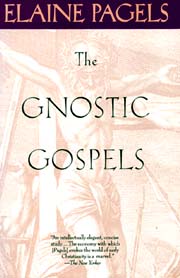


The Gnostic GospelsAncient Documents Shed New Light on Early Christianity Author: Elaine Pagels
This groundbreaking book introduced many people to the amazing manuscript finds in the desert at Nag Hamadi, manuscripts that, when analyzed, brought questions about the real beliefs of early Christians. Like the Dead Sea Scrolls, these ancient documents were concealed in a clay jar where they had apparently remained since somewhere around the year 200. Both the Dead Sea Scrolls and the Nag Hamadi documents were discovered in the 1940s. Ignorance and politics kept the Nag Hamadi texts from scholars for many years, but when finally these documents were made available, historians discovered many contained stories about Jesus and his followers and these stories often presented a different viewpoint from that of the gospels of the New Testament Diverse ViewpointsOf the 52 texts that were eventually translated to modern languages, some were already known to scholars from other existing copies, but others were previously unknown. The Gospel of Thomas and the Gospel of Mary (Magdalene), for example, gave us many more sayings of Jesus, and some seemed to contradict the familiar stories of the gospels of Matthew, Mark, Luke and John. Pagels speculates that these unknown gospels were concealed because they were rejected by the bishops of the Christian church for inclusion in the New Testament. They were either considered heretical documents, or they simply didn't fit with the picture the Church wished to give the world about Jesus. Scholars do date the Nag Hamadi documents from a later time than the four New Testament gospels, with most written many generations after Jesus' lifetime. The ideas in some of them challenge the core beliefs of today's Christianity, and Pagels notes that some people today are voicing the same "heresy" that is expressed in many of the documents. The Nag Hamadi texts present diverse points of view but what they mainly have in common is the idea that Jesus' real teaching was about acquiring spiritual knowledge and the quest for this knowledge is personal. Salvation does not come through ritual and stated belief but through achieving "gnosis" or personal knowledge of God. The people who pursued spiritual gnosis are called Gnostics and they were apparently quite numerous in the years before the Council of Nicea created the Nicene Creed in 325 AD. Before that, there was no recital of "I believe" for Christians. Christians believed a variety of things and churches did not all have the same practices or insist on acceptance of the same doctrines. A Threat to the Organized ChurchPagels discusses a number of ways that Gnostic beliefs threatened the organized church and she thinks the "catholic" (as in "universal") church won out in the end because it offered a framework that was comfortable for people and it had the organizational resources to perpetuate itself. Eventually it also had the power to enforce its system of belief and worship, and brand everything else as heresy. The Gnostic Gospels make it clear that not all Christians of that era thought Jesus was divine, nor did they believe in the resurrection. They said Jesus appeared to others following his burial in a spiritual, not physical, form. They say the resurrection can only be understood by spiritually mature people, who can see beyond simplistic explanations of "rising from the dead." They say mankind must evolve spiritually and that cannot happen if people continue to proclaim the same doctrines and do not seek to advance in spiritual knowledge. The bishops pushed the idea that salvation came only through the church and through accepting the standard doctrines taught by the church. Nothing more was needed, and subjectively deviating from these core doctrines was simply heresy. Orthodox Christians also believed in martydom and many were persecuted and killed by the Romans in the years before Constantine made Christianity the state religion. Gnostics mainly thought dying unnecessarily made no sense, although they generally would refuse to deny that they were Christian and some were executed. Pagels shows us that Christianity once had diverse forms, and people calling themselves Christians had serious disagreements about what it meant to be a Christian. The core beliefs today -- that Jesus died on the cross and arose from the dead -- were much in dispute. Christians also disagreed on what that meant. Today's doctrine that "Jesus died for our sins" would not have been accepted by many Christians of this early era. Many saw Jesus as a spiritual teacher who wanted to help people achieve spiritual wisdom through a variety of practices that were given only to those who were ready to receive them. He spoke in parables for the masses, but the spiritually mature could see his teachings on a deeper level. Eastern RootsAfter finishing The Gnostic Gospels, I picked up a copy of Man's Eternal Quest, a book of sermons by Paramahansa Yogananda, and found this: " The Hindu sages and yogis say that matter is materialized mind-stuff, and some of them, like Jesus, have proved this truth by demonstrating the power to materialize their bodies and other physical objects." Yagananda was an Indian yogi who came to the US in the 1920s and taught Eastern yoga to Westerners, and he wrote these words long before the Nag Hamadi texts were found. When he died in 1952, the mortician certified that, 20 days after his death, his body showed no signs of decay. He had perfect mastery over his life-force as he had always told those he taught. His explanation of how Jesus could have appeared as a physical person to his disciples fits the reports of those who saw him. Like Yogananda, could Jesus have converted "life force" to matter and created a material body seen by his associates? Gnostics made a big distinction between the physical body and the spiritual body and believe the spiritual body is the "real" body. Some even suggested that Jesus did not suffer, that he withdrew to his spiritual body during the crucifixion. Yogananda taught the same belief in the spirit body. For him, a spiritually advanced person spends most of his time in the other world and can separate from his physical body at will. Anyone who has read his Autobiography of a Yogi will remember the stories of his guru, Sri Yukteswar, who could bilocate -- be in two places at once! Advanced yogis can also materialize objects at will. Pagels is aware of the parallels between Gnostic thought and Eastern spiritual traditions. Yogananda said in another talk to followers, "When Jesus told his disciples to have faith, he didn't mean blind belief." In another talk, he stated, "I do not speak from book learning but from perceptions of God." He constantly urged everyone to meditate and to seek God within the silence. When Gnostics expressed similar ideas, they were reviled by the bishops as advocating an invisible world rather than the world of the senses that we see around us. The bishops could not control an invisible world or speak for a God who must be discovered within each person. Their natural reaction was to reject such ideas. A Gnostic Comeback?The Gnostic Gospels is fascinating reading, but it is a small book, and Pagels has chosen the material that seemed most compelling to her. Within those 52 documents that lay concealed for centuries, there must be a lot more information about the ideas of early Christians. It's taken more than 50 years for material from some of these documents to become well known. For example, it is the Gospel of Thomas (subject of Elaine Pagels book, Beyond Belief) that tells us Jesus loved Mary Magdalene more than any other disciple and that he used to "kiss her frequently on the lips " Dan Brown was influenced by this in writing his blockbuster best-seller, The Da Vinci Code, and the idea that Jesus may have been married to Mary Magdalene has been scrutinized in a number of popular books. For many of us, the idea of a married Jesus is no longer shocking. Christianity may after all evolve, as people ponder words from long ago which have the power to influence our beliefs today, just as they shaped beliefs of followers of Jesus some 1800 years ago. Can we once again accept a variety of beliefs and practices under the banner of Christianity, or will organized religion repeat its cycle of trying to stamp out ideas it does not and cannot control? Amazon.com page for this book: The Gnostic Gospels |
 |
 |