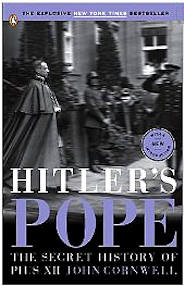
The World War II years brought the atrocities of Hitler — the systematic rounding up and killing of the Jewish people — and "Christ's Vicar on Earth," the Pope, did not speak out in protest. In the years before he was Pope Pius XII, Eugenio Pacelli had negotiated an agreement with Hitler ... now this shocking narrative alleges that he ignored pleas from world leader to protest the deportations and genocide of the Jews, and his intervention could have made a difference.
I well remember the thin ascetic face of Eugenio Pacelli, Pope Pius XII, looking down at me from the Catholic classrooms I sat in as a child, listening to the nuns in their long robes, encourage us to donate money to “ransom pagan babies” and extolling the sanctity of the Holy Father. I remember the devotion to the Pope as head of “the Mystical Body of Christ” and the image of Pius XII with a rosary in his hands. He and what he stood for was distant from my life as a schoolgirl, but his influence pervaded my world, more than I could know in those early years. Those were years when the Church constantly put forth Mary as the chaste role model for little girls. Mary, the mother of Jesus, became not a person, but a goddess whose persona was controlled and manipulated from Rome.
The Catholic Church was an institution that elevated obedience above all the other so-called virtues. The Pope, infallible in matters of faith and morals, was supposed to be the source of all knowledge and wisdom. This was a religion with no component of personal seeking for truth and knowledge; no spiritual truths to be gained through individual desire and effort; all that was required to be a Catholic in good standing was allegiance to the Pope and acknowledgement of his teachings. Thinking for yourself was not encouraged. Whatever your problem, look to the Church and its Pope, the Vicar of Christ on earth, for the answer. The ubiquitous pictures of Eugenio Pacelli in classrooms, church halls, and homes were a reminder of the authority that claimed descent from God Himself.
What kind of a man was Pius XII, the Pope during the terrible years of World War II? A book by John Cornwell has delivered a devastating indictment of the autocratic papacy of Pius XII, who was Pope from 1939 to 1958. In Hitler’s Pope, Cornwell paints a picture of a man so determined to preserve and build the authority of the Holy See that he insistently maintained a “neutral” position that allowed Hitler to torture and murder millions of Europeans, mainly Jews. The facts of the Holocaust are well known, but Cornwell explores Pacelli’s years before he became Pope, when he was nuncio to Germany and later Vatican Secretary of State. In these roles, he persistently pursued a Concordat with Hitler’s Reich that would separate the sphere of politics and religion. Over many years of negotiations, the Reich Concordat became a reality and played right into the hands of Hitler, who was only too glad to leave the Vatican and Catholics unmolested in return for their silence on the atrocities he committed against the Jews and others.
Response to the Holocaust? Silence
That Pius never spoke out against the outrage of the systematic rounding up, torturing, and killing of six million Jews is established. But Pacelli’s defenders have always claimed that his mild statements about helping innocent victims of the war means he DID speak out or that he didn’t know about the extent of the killing. Cornwell had access to new sources and to the Vatican archives as well, and in those old papers is the evidence that the Pope was well informed about what was happening throughout the war years, beginning with the program against the Serb Orthodox Christians in Croatia in 1941. The Catholic Croat regime was responsible for killing two million Orthodox Serbs with the complicity of the Catholic hierarchy. The Pope never condemned this.
When Hitler was rampaging through Europe, the Pope was mainly concerned with preserving Rome and particularly Vatican City. When the Germans finally occupied Rome and began rounding up Roman Jews (who had a history in Rome going back 2000 years), the local population came to their aid, bringing clothing and food to the place where they were held awaiting trains to the concentration camps. There were many protests and attempts to hide and save some of the Jews by local residents. But Pius XII never did anything to stop the deportations of Jews living in the very shadow of the Vatican. Cornwell refutes the arguments to the contrary, showing Pacelli was willing to be silent on the matter of the Jews in return for the Nazis not attacking papal properties.
The Church's "Neutrality"
Allied countries like Great Britain and the US constantly asked the Pope to intercede with Hitler to stop the atrocities, but Pacelli maintained his silence on the issue, stubbornly insisting he could not take sides, as if there were no moral issues involved. His only statements were mild rebukes and appeals to Christian charity to help those made homeless by the war. The Vatican did contribute money, food and needed items to victims of war, including contributions to Jews, but the Holy See never used its considerable worldwide influence to denounce Hitler. When Hitler was declared dead, the Vatican asked that masses be said for him. They never had any masses said for the six million Jews who died in the Holocaust.
Cornwell takes his thesis even further, alleging that Pacelli was basically anti-Semitic and that his paranoid fear of Communism kept him from seeing the evils of National Socialism as practiced by the Nazis. Pacelli spoke out against persecuting people based on their race or origin, but he never used the words “Jews” or “Nazis” in any of his speeches. He did not even intercede for the Jews who had converted to Catholicism, although some bishops did. To Hitler, a Catholic Jew was still a Jew and these converted Jews, including nuns and priests, were sent to the concentration camps like any other Jew. The Catholic Church in many countries assisted the Nazis by supplying birth and baptismal records that helped establish who was a Jew. There was sporadic resistance by local bishops, but their influence was hampered by the “neutrality’ of the Pope.
No Friend of Democracy and Diversity
In his later years, Pacelli inveighed against New Theology and the Catholic worker movements in France and the US. He only begrudgingly acknowledged democracy as an acceptable form of government, preferring instead an autocratic state that was in line with an autocratic Church. He saw no value in diversity, which we in the US have come to value. Cornwell implies that Pacelli lacked empathy with the Jews, who he considered outside the fold of the true Church. Pacelli had spent his whole life in service to the Church, including long years revising the Canon Code of Law. To him, this written code represented the ultimate truth and only people who accepted its truth were worthy of his support.
Cornwell does not say Pacelli lacked moral courage, but his narrative makes it plain that Pacelli had always lived well, having luxurious residences while he was nuncio to Germany and in his work in Vatican City. He never had to experience any hardships and as Pope had legions of personal servants. Did he simply lack the ability to understand human suffering? Did his own fear of a possible invasion of Vatican City keep him from speaking out? In fact, there was evidence that Hitler considered storming the Vatican, but backed off because of the certain negative reaction of the local population. Cornwell makes a convincing case that the Vatican would not have been overrun with Nazi storm troopers if the Pope had spoken forcefully against the deportation of the Jews. The Holy See had considerable influence in the world and He apparently thought by appeasing Hitler, he could play negotiator, but by failing to speak out against the atrocities, he reduced his credibility with the Allies as a spokesman for peace.
Changing Values in Society, But Not in the Church
The majority values of civilization in this new millennium are fundamentally different from the value placed on obedience to central authority preached by Pius XII. In Hitler’s Pope, we see the tragic consequence that resulted from the Pope’s doctrine of blind obedience to papal authority that, by analogy and by the provisions of the Reich Concordat, made deference to political authority also a necessity. But isn’t indifference to suffering likely to follow from any ideology that puts so little responsibility on each individual and instead preaches following the lead of central authority?
Many have complained that Christianity had turned into Churchianity. In the Catholic Church, we have a perfect example of that. For many who have stopped attending church, it was this policy of taking all your beliefs from a sterile Canon Code of Law that drove them to other movements that emphasize a personal spirituality that does not condemn those of other creeds, because each seeker must find the truth on his or her own. Many of the mystic traditions believe there are many routes to truth, and the old initiatic religions placed the responsibility for spiritual growth, not on an organization, but on the individual. Pius XII would have hated the New Age, as he hated the “worker priests” of France and the wonderfully creative ideas of Pierre Teilhard de Chardin.
It was a long time ago that I sat in a Catholic classroom with a picture of Eugenio Pacelli looking down on me… a long time ago in years and in spirit, but the echo of those years leaves me with an unsettled feeling about these revelations about Pius XII. Does John Cornwell go too far in his condemnation of Pacelli? The title of the book is still a shocker to me, and I understand how many people will find its contents unpalatable. But it seems we must take another look at the man who was Pope Pius XII and consider how his very beliefs -- which were synonymous with those of his Church -- may have contributed to the worst crimes against humanity in known history.
That the Catholic Church is in the process of making Eugenio Pacelli a saint amounts to a cover-up of the truth about those horrible years.
Buy Hitler's Pope: The Secret History of Pius XII at amazon.com.
See my review of James Carroll's book Constantine's Sword: The Church and the Jews, A History about the Catholic Church and the Jews, avauilable at amazon.com.