


Author: John Shelby Spong
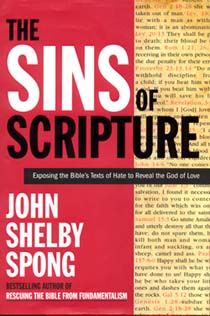 Reviewed by Theresa Welsh
Were you taught that the Bible is "the inspired word of God?" Do you believe the stories in the Bible are literally true?
|
Bishop Spong takes on these controversial issues in this book, which dares to say that the Bible is full of errors. Yes, some of what's in the Bible is not only NOT literally true, it simply reflects the spin put on events by the writers, many of whom were not actual participants or eye-witnesses. The Bible is a product of historical circumstances which we mostly no longer understand. Radical though his ideas may be, Spong's scholarship and knowledge of both Old and New Testament give his conclusions credibility. He tells us he has personally read the Bible many times and "could not fail to notice its gory passages that did not jibe with what I had been told about either God or religion." He finally came to the conclusion that these stories, rather than being considered literal truth, should be read as an "epic" of the Jewish people, in the same way as the Illiad and Odyssey are epics of the Greeks. Using Scripture to Justify HateSpong does not mince words about the "sins" of religion in general and Christianity in particular. He reminds us that through the ages the Church has engaged in persecution and torture of those who would not sign on to its dogma. Religion is often about control. The church is the controller and, in exercising control, has supported abusive behavior directed at select categories of people. Women, children homosexuals, Jews and non-believers have been some of their targets. Spong gives us the passages of scriptures usually quoted to justify hateful attitudes and violent actions; he then gives us a deeper insight into the circumstances behind these passages and shows why the fundamentalists have gone astray in their interpretations. I found his discussion of each of these areas enlightening. When people start spouting scripture to explain that God hates homosexuals and why it's ok for men to beat their disobediant wives and children or why only Christians will be "saved" — this tends to turn a lot of people away from religion. Scripture has been the justification of so much hateful behavior, and religious differences the cause of so many wars, that many people have concluded that there is nothing of value in either the Bible or religion. Bishop Spong does not spare religion in his critical analysis. He says the enemy is dogma, the hardening of beliefs into a fixed system, no longer subject to discovery or change. Instead, he tells us, we must move beyond our security zone of assured dogma and carved-in-stone theology. "To step beyond religion," he writes, "is to grow into human maturity." So far so good. So How Should We Interpret Bible Stories?But in Bishop Spong's new view of the Bible as epic, we are left to our own interpretation. Particularly with the New Testament, Spong picks his way through the stories of Jesus, accepting some and rejecting others. He does the same with the letters of Paul. I (along with lots of other women) don't think very highly of Paul, so I was gratified to read Spong's criticisms. But he also credits Paul with some insightful words about love. Spong bases his choices on what to accept in large part on the historical context, and reminds us that the four Gospels were written by a generation that did not know Jesus. These Gospels are the work of men who wrote within a Jewish frame of reference, with an agenda of making Jesus appear to be the Jewish Messiah who fulfilled earlier prophecies. The writers also make Jesus larger than life, a heroic figure who inspired a large following. Bishop Spong likes the inspirational part of the story, but he rejects the most fantastic of the tales and pretty much all of the theology spawned by the Jesus story. His Jesus did not walk on water or feed hundreds with a few loaves and fishes, nor did he rise from the dead and ascend into heaven. And he did not die for our sins. Thank you, Bishop Spong, for that last one. I do not see why Jesus should have "died for our sins" — aren't we all responsible for our own sins? And what about all the people who lived before the crucifixion? What is the Role of the Christian Church?I enjoyed reading Bishop Spong's ideas and found the book useful, but it feels incomplete. Pardon my cliché, but has the good bishop thrown out the baby with the bath water? We have so little historical corroboration of anything we've been taught about Jesus, that what are we to think? Or does it even matter? Bishop Spong does not seem to feel that keeping Christianity alive is as important as moving the human race toward a greater and wider consciousness. In that, I agree with him, but I wonder what role that leaves for the Christian Church. Bishop Spong has written a number of books that take a different view of the Christian faith and oppose the fundamentalism that has taken hold of a part of our society. He shows in this book and in his other books (see, for example, Rescuing The Bible From Fundamentalism) how the Christian Right has used religion to push a conservative agenda that often includes hatred of those who don't agree with them. While we in the US still claim to live in a country where people are free to think and say what they want, I join Bishop Spong in finding it deplorable that people use scripture as a reason for hateful and vengeful attitudes. Surely, that is not what God intended. |
|
 | See my |
 |
