


Author: Barry Lynes
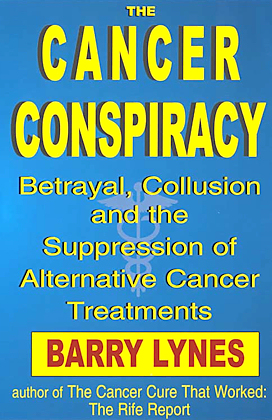
Reviewed by Theresa Welsh
Have the real cures for cancer
and other diseases been suppressed?
Drugs You Take Forever Equals ProfitsLike millions of Americans, I've become thoroughly disgusted with the high cost of medical care and its general ineffectiveness. As you look around at the plethora of ads on TV for high-priced drugs, and see the billions of dollars going to high-profile research institutions to combat health problems like heart disease and cancer, it's not too difficult to start thinking that all these organizations that make so much money off illness might not actually want to find a cure. The big drug companies refer to these diseases as "markets" (as in "the cancer market" or "the diabetes market"). No one wants to lose their market, especially when they can charge astronomical prices for life-saving treatments like the $1000 per pill cure for Hepatitis C (the cost in India for the same pill is $4!). Isn't it far more profitable for big drug companies to sell you a "maintenance" product that you have to take for the rest of your life than to offer a cure? If they do have a cure, why shouldn't they make it obscenely expensive; after all, wouldn't sufferers pay any amount to be cured? Shouldn't drug companies wring as much money out of their cure as they can for their shareholders? Otherwise, shouldn't they just withhold the cure from the public so they can make more money off selling maintenance drugs? Other players in the health care market are also hurt by selling cures. Wouldn't the well-paid researcher have to find something else to do with his life if a cure for cancer was actually found? Wouldn't big charities with their gulf outings and 5K runs have to fold up and lay off their staff? Are these questions the ramblings of a paranoid mind? Or could they be true? The Royal Rife DiscoveriesWhen I first learned of Barry Lynes' books (The Cancer Cure That Worked and The Cancer Conspiracy ), I was intrigued and began a search for information about the person that Lynes says found the cure for cancer. That person is Royal Raymond Rife, who did his work back in the 1930s and died in 1971. Rife was not a medical doctor, but a researcher based in San Diego California. In 1933, he made public a great achievement, a new microscope which he had worked on over many years. Rife was not satisfied with the electron microscopes of his era (and still in use), which required that specimens to be observed had to be dead because of the deadly chemical stains applied to them. Rife's "universal microscope" allowed "staining with light" and was capable of magnifications far greater than any other microscope in existence. Using this invention, Rife was able to observe tiny living micro-organisms that inhabit the human body, organisms he felt caused diseases such as cancer. But that was not the end of his contribution. Because his microscope let him observe living organisms, Rife was able to experiment with methods of killing them. He found that bombarding them with the right frequencies (radio & audio) could cause them to literally explode. The trick was to find the right frequency for each organism. This treatment was painless and harmless and cheap when used on people. The Enemy: The AMASo why didn't other researchers follow up on this amazing and potentially life-saving work? According to Lynes, because the medical profession, led by the American Medical Association (AMA), was strictly interested in making money. The head of the AMA during that era was Dr. Morris Fishbein. Lynes says Fishbein heard about the Rife mechanism and wanted a piece of the action; he offered Rife a deal whereby he, Fishbein, would get a huge share of the profits from the sale of Rife machines and in return he would give the blessing of the AMA and get his friends at the FDA (the federal agency that would have to approve such a device) to move fast and favorably on this treatment. Rife, seeing Fishbein as a crook, said no. Fishbein and his cronies reacted savagely, making sure Rife got no research money and moving to discredit his work with the press and the public. Rife tried to fight back but was no match for the ruthless forces against him; he began drinking and withdrawing from the research he loved. With no money and powerful enemies, he could no longer pursue his passion and he became a broken man. Actual Cures in 1934Could Rife's frequency treatment cure cancer? The evidence says yes. In 1934, a clinical trial was conducted using Rife therapy. One of Rife's close friends, Dr. Milbank Johnson, along with the University of Southern California, appointed a Special Medical Research Committee to bring 16 terminally ill cancer patients from Pasadena County Hospital to Rife's San Diego Laboratory and clinic for treatment. The team included doctors and pathologists assigned to examine the patients after 90 days (if they were still alive). The results? All were cured, using Rife's frequency machine. The treatment was painless, with few if any side effects. The total cost for this treatment was the cost of the electricity. Compare that to today's average cost of treating a cancer patient of at least $300,000 -- a lot of money flowing to those cancer treatment institutions. Who would deliberately turn off such a spigot? Fishbein, the Enemy of a CureA number of doctors who had learned of Rife's work had begun using his method with good results. But the AMA, led by Fishbein, was determined to stamp out any furtherance of Rife's work. Fishbein was behind the FDA presectution of Rife's colleagues, including a raid on the offices of Dr. John Crane. Crane's equipment and notes were seized and his office closed. The AMA brought a lawsuit against Crane and Rife, which Rife ultimately won (the judge ruled the AMA had used its monoply power to suppress Rife's work), but he was by then an alcoholic, unable to take the brutal retaliation and persecution he had suffered by his refusal to roll over to the AMA. His lab had suffered a mysterious fire, and some of his supporters had also died under suspicious circumstances. Doctors using his method of treatment risked their careers and most stopped. Rife's amazing research was simply lost to generations of cancer patients treated instead with expensive and painful chemotherapy. Lynes believes the AMA, in collusion with the FDA, continues to obstruct any approach but the drugs and surgery of conventional medicine. He writes "Doctors who continue to live in the AMA tent as that organization's murderous history becomes known must be viewed as akin to German doctors in the concentration camps during the Nazi era." It's a pretty extreme statment, but may reflect anger that other kinds of treatments are not even given a try. For example, another tale of suppression is the story of Neal Deoul, and his battle against a crusading state attorney general who would deny the world the benfits of cesium, another alleged cure. Rife was not alone in finding the door to innovation in cancer treatment slammed shut. The powerful interests pushing chemotherapy have won the day, and it seems unlikely we'll ever see treatments here in the US that don't involve someone making huge profits, since we live in the one civilized country in the world where medical care is a for-profit industry. The Modern RevivalToday there is a revival of interest in Rife's research, and Rife-inspired machines are being used in Europe to treat cancer and other diseases. But, you might ask, haven't we learned a lot about cancer since the 1930s? Rife's work is being integrated into contemporary knowledge about cell structure. As to whether a Rife device actually can cure cancer, here is an answer given at the Rife Forum, a web site for European use of Rife technology: Rife claimed that his original machines cured cancer. We have no reason at the present time to doubt this claim but it has not been absolutely proven. We don't know exactly how the original machines worked and so the modern machines probably don't work in exactly the same way. Some modern machines have been shown to have been useful in the treatment of some cancer patients but it would be misleading to claim that they represent an absolute cure for cancer. There is general agreement that Rife type machines have been useful in the control and management of many diseases including many serious ones that haven't responded to conventional treatment but it would be wrong to say that these machines in their present form are a cure for any specific disease. The Hungarian Company OncoTherm has done several clinical studies in Europe on treating cancer with their Oncotherapy device which uses a Rife frequency modulation. These trials did show a significant improvment in health and a reduction in tumour size. Why aren't Rife machines in use in the US? Same reason as before -- the FDA. It takes a lot of money to do the tests required for FDA approval. No one is getting funding to do the work needed to legalize this type of therapy. Lynes writes that "billions of dollars in research, clinical trials, and worthless, approved drugs by old boy networks within the FDA and the National Institute of Health (NIH) have caused billions of dollars to be squandered on dangerous, immune system-destroying drugs which didn't help the victims, but merely perpetuated a corrupt medical monoply." The BookWhile the Royal Rife story is fascinating, Barry Lynes' book leaves much to be desired. It is a poorly-organized rant against the defamers of Rife that will probably alienate some readers. It would have been better if he had laid out his case in logical order, explaining what is wrong with the present system, how it is different from Rife's method both technically and in terms of what happens to the patient, and what is being done today to promote Rife's work and explore it further. For example, Lynes refers to chemotherapy as "torture" but does not explain how chemotherapy is supposed to work and exactly how it tortures the patient. I have not personally known anyone who has undergone chemo, so I don't know if it is or is not torture. Please explain. Lynes also makes many inflammatory remarks comparing the medical establishment to Nazi experimenters. While their treatments might be painful to those receiving them, it seems extreme to me to make such a comparison. He makes liberal use of quotes in the book (an effective method, if only they had been better organized and with more supporting facts), often quoting the Nuremberg Nazi trials. I have to agree if there was an organized suppression of a cure for cancer and in its place people have been getting painful and expensive chemo-therapy that there is some truth to a comparison with Nazi torture and genocide, but I do not agree with a sweeping painting of the whole medical profession with such a brush. But worse than that, why make statements so inflammatory they will drive away potential supporters? And, the main reason to oppose chemo is not that it is painful and expensive, but because it is ineffective. If I had been writing this book, I would have driven home that basic point. Morris Fishbein of the AMA: An Enemy of Health Care for AllIn regard to Morris Fishbein and the AMA, I did an internet search and found a number of sites that confirm what Lynes says about him, that his main interest was in lining his own pockets and using the power of the AMA to increase the income of doctors. I also consulted one of my favorite books, The Social Transformation of American Medicine by Paul Starr (still in print and available at amazon), a book that was a Pulitzer Prize winner in 1984. Starr has nothing good to say about Fishbein, who, according to Starr's book, was the defendant with the AMA in an anti-trust trial in 1938 when the AMA tried to break a group health plan for low-income people. Starr makes it plain in his book that the AMA established a pattern of opposing efforts to expand health care to more people or to set up programs for the poor. It would seem that our present unfair and overpriced so-called health care system is a legacy of Morris Fishbein and his ilk. Lynes Should Have Stayed on MessageTo explore the subject logically, one would also have to deal with Rife's micro-organisms. Exactly what are they and are they the cause of cancer? Is there any corroborating evidence that these organisms exist and cause cancer? Even if there isn't, it does not discredit Rife's work. After all, his method was used on cancer patients who were actually cured. So what was it about what Rife did that cured them? Lynes does not tackle these issues. It is as though his anger was so great as he wrote this book that he could not get outside his outrage enough to present the facts. I understand his anger, but I want more facts. Lynes also throws in short chapters on other alternative treatments for cancer that have nothing to do with Rife. These merely distract, and do not provide enough information to be of much use. Is his main point that alternative cancer treatments work and chemo doesn't, or is his main point that the medical-industrial complex (a mirror of President Eisenhower's warning about the growing power of the military-industrial complex) is dangerous and working against the best interests of the American people? Both points are probably true, but Lynes zig-zags all over the place, jumping from one topic to another. As with any other conspiracy, the reader must come to his own conclusions from the material presented. Personally, I believe Barry Lynes when he says that powerful interests do not want a cure for cancer or any other disease for which they reap huge profits. Nor will any lone maverick researchers be allowed to bring to the public any new treatments, no matter how effective they may be. How would it look if a cure were to come from someone working without the billions of dollars the government has poured into institutions like the National Cancer Instititute? Back in the days of President Nixon, the US government declared a "War on Cancer." Billions of our dollars have been given to big research organizations with almost no results. You can wonder about that as you read Barry Lynes' angry words. Despite his abrasive approach to the subject, I think Barry Lynes has something important to say. The medical establishment in America has much to answer for. |
 |
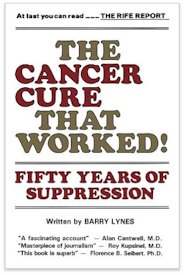 |
Click the links below to go to the amazon.com pages for these books by Barry Lynes:
Lynes updated his original ideas in a 2009 edition, available on amazon: Links to More Information about Royal Rife
|
See my reviews for these books:
 American Health$care by Dr. Richard Young
Deadly Spin: An Insurance Company Insider Speaks Out on How Corporate PR is Killing Health Care and Deceiving Americans by Wendell Potter
Overdiagnosed: Making People Sick in the Pursuit of Health by Dr. H. Gilbert Welch
Worried Sick: A Prescription for Health in an Overtreated America by Nortin M. Hadler M.D.
Overhauling America's Healthcare Machine by Douglas Perednia, M.D.
The Cancer Conspiracy by Barry Lynes
Critical by Tom Daschle
Do Not Resuscitate by Dr. John Geyman
Vibrational Medicine by Richard Gerber, M.D.
The Body Electric by Robert O. Becker
Manufacturing Depression by Gary Greenberg
 And read my personal Healthcare Rant
What's Wrong With American Health Care?
 |
 |
