


Author: John Shelby Spong
 Reviewed by Theresa Welsh
Here is a book for people
who can no longer accept standard Christian theology.
|
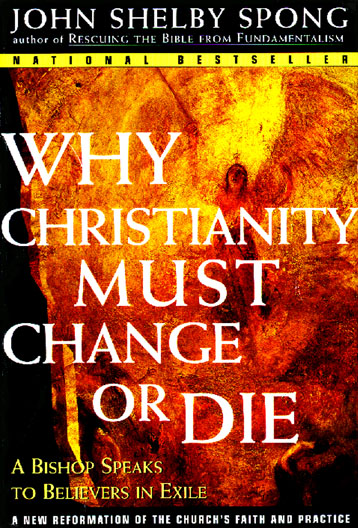
In many ways, John Shelby Spong mirrors my own thinking about Christianity, but his long ecclesiastical background as an Episcopal Bishop provides an enlightened vantage point. Christians in ExileSpong considers himself in "exile" from the standard doctrines of Christianity and he takes on most of these doctrines in this controversial book. He says the old concept of a theistic God is no longer useful in a modern world. God is not a person who lives in the sky and tinkers with our lives and sits in judgment. The steady march of knowledge about the vastness of the universe and our puny place in it has made that God obsolete. Spong is at his best when he is tracing the biblical roots of this God and showing how they arose, not out of any divine revelation, but were the natural product of the tribal societies with whom they originated. He even finds a parallel in Biblical times with his current "exile. " When the Babylonians took the Jews into captivity, the Jews had to leave the place associated with their God, Yaweh. The homeland given to them in the time of Moses, and the temple to the God who led them from Egypt were gone. They were in exile, cut off from the sources of their faith. Spong sees a parallel today, as people discard a belief system that has come to sound nonsensical. The Jews were able to find their way out of exile and continue to exist as a people. But can Christians do the same? Demolishing OrthodoxyI loved his chapter on "Jesus as Rescuer" in which he demolishes the doctrine that "Jesus died for our sins." He goes on to argue against the Virgin Birth, showing how, to people of the time, a sinless Jesus needed sinless progenitors. It was only after it was discovered that the mother contributes genetically to her children did the church invent the doctrine of Immaculate Conception (meaning Mary was conceived without sin). I was amused at his discourse on the Ten Commandments, as he actually pronounces some of them "immoral." That's pretty heavy stuff, but he is absolutely correct about this. My daughter and I recently tried writing down the ten commandments to see if we knew them all. We went to a Bible to verify our efforts and discovered the actual wording, where women are equated with houses and asses. The words are usually modified in listings of the Ten Commandments so these archaic (and insulting) words are left out. As a set of rules to live by, the Ten Commandments, along with so much of Christian doctrine, leave us disappointed and unbelieving. I was brought up Catholic, and I don't think the Catholic Church will be following Bishop Spong into rejection of these long-standing Christian ideas. I don't know much about Episcopalians (a church started by a king who wanted to divorce — make that murder — his wife!) but it seems to me these doctrines are the lever used to control people and perpetuate the church. The church will never let them go. In the case of Catholics, the holdovers from medieval times are so extensive and embedded that it is doubtful the Vatican can update anything. The church refused to accept birth control, married clergy, and other eminently sensible ideas, so it is unlikely to embrace a Jesus who did not die for our sins. Worship?That brings me to other ways I disagree with Spong. He continually uses the word "worship;" he uses the word to mean the activity that goes on inside churches. It seems to me he has hung onto this word because there is no meaningful word for the hodgepodge of activities that occur inside church buildings. As to the word itself, surely a God who is in all of us and who encompasses the vast universe has no need to be worshiped. The whole idea of worshiping God is also obsolete, along with the other concepts Spong so deftly kills off. If churches are not "houses of worship," what are they? Do they serve any theological purpose, or are they mainly good for holding potluck suppers and rummage sales? Power of PrayerI think he also misses the mark in his discussion of prayer. He asks why someone who is prayed for should recover from their illness while someone who is not prayed for does not recover. What kind of a God would be so influenced? What is wrong with this analysis, in my opinion, is the inclusion of God, who does not have to be involved in what we call prayer at all. Just as we do not need to worship God, neither do we need to petition him/her. Prayer, I believe, is really an aspect of non-local consciousness. It is a type of psychic phenomena if you will, a way one mind or spirit reaches out to another. The question is not who we pray TO but who we pray FOR. We touch the other person or event with our spirit or inner energy. Prayer can be studied scientifically (to some extent) and studies have been done that seem to indicate prayer works. See the books of Larry Dossey, Deepak Chopra, and Bernie Siegel. Don't forget the studies that showed even plants grow better then you pray for them (see my review of The Secret Life of Plants). Isn't prayer an aspect of the inter-connectedness of all life? The AfterlifeIn the same way, Spong does not offer us much in his discussion of life after death. While I like a lot of what he said about the value of what we do in this life, the real question we all want answered is what happens when we die. Christian doctrine on this has emphasized the divine judgment which separates the good from the bad, relegating us to heaven or hell. Spong traces the theological roots back to the theistic God who is like a good parent, and the way these concepts of the next life were used by the church to control behavior in this life. But is the concept of life after death totally bound up with reward and punishment? I think not. Today we have much evidence from Near Death Experience (NDE) and Out of Body Experience (OBE) and the testimony of mystics like Robert Monroe. There is a mini boom in contacting the dead (consider the popularity of John Edward's "Crossing Over") and millions of people accept these sources as proof that our spirits go on after we "cross over." Again, where is God? He/she does not have to be in this equation either. The evidence seems to indicate that we take our emotional baggage with us to the other side, and we continue to grow spiritually in this new realm. I personally like the ideas of the Spiritist Movement (as originated with Allan Kardec in France — see my review). It examines the evidence from contact with the spirit world and acknowledges that our concepts of life after death will change as new sources of information are available. Who is Jesus?I also need to mention Spong's attitude toward Jesus. Of course as a priest and bishop, Spong has continually had Jesus in his life, and to say Jesus is just an interesting character in some ancient and unverified stories would be too painful. But Spong is willing to relegate many items in the Bible to mythical status, so why does he accept some (not all) of what is said about Jesus? Even reinterpreting the historically unacceptable (the birth in a stable, attended by three wise men, for instance) is hedging on whether anything written about Jesus is true. I agree that Jesus as described in the New Testament has much to offer. But how can we know what really happened thousands of years ago when the only testimony was written years later and has the bias of its time? Spong will not eliminate Jesus from his belief system, but many others who haven't spent decades in liturgical orthodoxy will. Jesus will continue to be a topic of great interest, as evidenced by the numerous and popular alternative history writers who have postulated many unorthodox ideas about him — he survived the crucifixion, he died at Masada, he was married to Magdalene, he founded the Merovingian dynasty, etc. These speculations are wonderfully entertaining, and I am a big fan of alternative history (see my many reviews of other books covering these topics). But I cannot base my most heartfelt beliefs on anything as speculative as the life of Jesus. We just don't know who Jesus was or what he did during his life, and there are those who claim he did not even exist. Wither Churches in the Future?So do all these transformations of the old Christian ideas mean there is no God? Not at all. I agree generally with Spong in his conclusions, but he is tied to his ecclesiastical past in a way that I am not. While I think churches have contributed to society by bringing people together and creating social bonds, and often doing good works, I cannot see how they can go on when the basic reason for their existence — their theology, including Jesus — can no longer be believed. Spong concludes his book by saying "I expect to enter even more deeply into the reality of the God in whom I have lived and moved and had my being." Amen to that, but it does not require a church, Episcopalian, Catholic, or otherwise. While humanity will continue searching for its roots and for meaning in life on our puny and insignificant (but beautiful!) earth, we need a totally new idiom to help us in this search. Buy Why Christianity Must Change or Die at Amazon.com.
|
|

 |
 |
 .
.
