


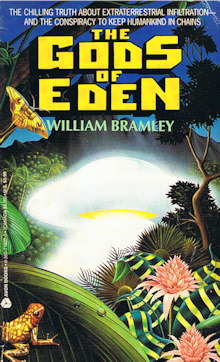
The Gods of EdenHave alien "gods" been manipulating humans Author: William Bramley
Reviewed by Theresa Welsh I first read The Gods of Eden some years back (the book was first published in 1989) and it made an impression on me as being a bit different from the other alternate history works I had read. At various times over the years I have picked it up and reread a chapter here or there. But recently I decided to read the whole book again, and this time I realized I had not fully appreciated the high level of research (with references, bibliography and Index) as well as the original reasoning and conclusions of this book which has since become a classic of this genre. Searching for an Answer to an Age-Old QuestionThis is not just another "ancient astronauts" sensational work. William Bramley had taken on a serious search when he sought an answer to this question: What is the reason mankind is constantly at war? He says he thought it would come down to human greed, which arises from the perception that SOMEONE benefits from wars. But as he took a long exploration through human history (consulting many different sources for information), he found something surprising. He found the presence of UFOs. He does caution us that he realizes the conclusion sounds pretty far out, but asks us to bear with him as he takes us back to ancient civilizations, to the Sumerians and Egyptians and Biblical times. But he doesn't stop with ancient sources, as many writers in this genre do, but continues his researches through the Roman Empire, the Middle Ages, Luther and the Reformation, the American Revolution and into modern times with Nazis and two World Wars. Gods Who Don't Appear God-likeIn ancient times, the histories that have come down to us mention "gods" who do not seem very godlike, who behave more like humans, with jealous squabbles, selfishness and brutal acts against their human subjects. Many documents from this era describe "gods" who come from another place, moving about in flying machines. Bramley calls them "Custodians" and considers the idea Charles Fort first presented that humankind may be "owned" by another intelligent race of people not of our Earth. Early man mistook these superior beings as "gods." These "gods" are no longer walking openly among us, but that doesn't mean they are gone. Throughout human history, there have been reports of strange flying objects (sometimes called "boats" or "sails" or "Comets") in the sky. The author walks us through a long list of usual arguments against the idea that these are piloted vessels from outside our planet and answers each of them. He does not go any further into explanations of the many sightings in past or modern times, as there are many books covering those.(For instance, try Wonders in the Sky by Jacques Vallee and Chris Aubeck -- see my review) His purpose is to state that evidence exists that we have been visited throughout our history and to present his theory of who these visitors are and why they are here. "Custodian" Gods Want us Warring on Each OtherMaybe early man took these powerful visitors as their masters, but understood they were not "god" in the sense of a Creator (unless, in a way, they were, because they may have altered human DNA). Bramley believes humans have a spiritual side that extends beyond physical death, but our Custodians do not want us to remember this fact. They want to keep us trapped in matter and to lose whatever understanding we once had of our true spiritual nature. Their domination of us may extend into the afterlife and cause us to continually return to earth in physical bodies. In the Garden of Eden, "god" wanted to keep Adam and Eve from eating the fruit of the tree of knowledge of good and evil. When they did, "god" became alarmed and said What if he puts forth his hand and takes also of the tree of life, and eats, and lives forever? We were meant to remain ignorant so we could serve these "gods" and not understand our true immortality or find our true salvation. The Custodians were opposed in ancient times by a Brotherhood, whose symbol was the snake (it was a snake who urged Adam and Eve to eat the fruit of knowledge). The Brotherhood's desire to raise humanity to higher spiritual awareness can be traced to one of the Custodians, who did not agree that the human race should be slaves. However, he did not prevail and over time, the Brotherhood branched into many organizations that became corrupted so they mainly serve the Custodians' purpose. Most of our major religions are part of this Brotherhood network, although their leaders and members may not consciously know it. Other organizations that use secret rituals, like the Freemasons, are also associated with this Brotherhood. Near the end of the book, the author devotes a chapter to what a Creator God might be like. Such a God may actually be the whole of many parts that include all spiritual beings (including us and our Custodians). He classifies religions as "custodial" or "maverick" or some combination, and he gives us a fascinating list showing the attitudes of each type. Maverick religions teach that man is spirit and must work out his own salvation. Interestingly, Bramley does not see monotheism as an inevitable or higher level of spiritual understanding. Because we believe in "One God" does not mean we are not getting the same old ideas planted by the Custodians. The aim of the Custodians in working through these religions is to keep mankind from understanding its spiritual nature, which must be grounded in ethics and personal responibility for spiritual growth. Religions with apocalyptic messages encourging one group to war on another serve the interests of the Custodians. Paying for War With "Funny Money"Some of the most interesting (and novel, in terms of books about "ancient astronauts") ideas have to do with money, or "funny money" as he calls "inflatable paper money." This is money created "out of nothing" by banks. It serves the purposes of the Brotherhood organizations by financing wars. It also keeps people and nations in constant indebtedness. His explanations of how this works are lucid and logical. From the banking business has come many of the behind-the-scenes Brotherhood movers and shakers, including such secret organizations as the Britsh Round Table founded by Cecil Rhodes who sought to establish a One World Government and a universal language. His motives were apparently pure enough, as he felt this would reduce the danger of war. Rhodes, who amassed a great deal of wealth and power in colonial Africa, patterned the Round Table after Freemasonry, whose members were also heavily involved in promoting Brotherhood causes. After Rhodes died, the Round Table spawned other secret organizations in America such as the Council on Foreign Relations and the Institute for Advanced Study (involved in developing the atomic bomb). Later there would be the World Bank and International Monetary Fund (IMF), as "funny money" went international, led by the Central Banks of deveoped countries. They are NOT Our FriendsWhile many people have come to believe we might be getting visits from aliens, there is no consensus as to whether these alien visitors are here to help or here to conquer (or maybe just curious). In Bramley's view, whoever these visitors are, who have been with us throughout human history, they are NOT our friends. When they presented themselves as "gods," it was to control us. When they thought we were hampering their purposes or there were just too many of us, they arranged for many of us to die. Bramley finds evidence that the custodians were behind the Black Death in the 14th century. There are stories of strange "men in black" carrying "scythes" associated with a deathly fog that killed those who encountered it very quickly. He says the image of these personages became the iconic Grim Reaper. What is startling as I write this in 2015 is how true it is that we seem to be constantly at war, and that hatred because of differing belief systems is often the cause. Bramley shows how Brotherhood organizations often support both sides in a war, providing funding and political or religious cover. Often the reasons for killing are fueled by an apocalyptic fervor that makes people believe they must kill all non-believers and this will usher in a "paradise" in this life and/or the next. Think of the 9/11 attack on the US that brought down the World Trade Center buildings, and think of ISIS with its Caliphate which is supposed to bring about an apocalypse, and the young people who believe it and are heading for war-torn Syria. Think of all the movements that have proclaimed that current inhabitant of planet earth were living in the "End Times." Whose interests do these ideas serve? The Gods of Eden is a well-researched look into human history, and into the phenomenon known as UFOs that has been there with us. This is perhaps the best book if you are wondering if everything you've been taught about our history may not be the whole story. Buy The Gods of Eden
You might be interested in my reviews of these books: |
|
 |
 |
 at amazon.com.