


by Colin Wilson
Reviewed by Theresa Welsh
|
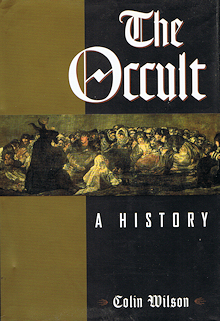
Wilson is a prolific writer best known for his books about paranormal and alternate-history subjects. When I saw one of his many books at a bargain rate from Barnes & Noble, I bought it. I'm glad I did because The Occult: A History is full of fascinating ideas. Originally published in 1971, this edition was republished (in hard cover, with a nice jacket, but cheap paper inside) by B&N. The ideas and information in it are as timely and interesting today as when it was written. Covering the Full Spectrun of Paranormal PhenomenaUnlike other writers who merely catalog and detail occult phenomena, Wilson attempts to formulate a theory that explains how such phenomena are possible. He covers precognition, hypnosis and mind connections, shamanism and special powers displayed by primitive cultures, the practice of magic and witchcraft, spiritualism, coincidences (today called synchronicities), healings, and tales of werewolves. But his heaviest emphasis is on the mystical experience, the heights humans sometimes reach in moments of unusual clarity and insight. These are the moments that make life more than a collection of ordinary actions, that take us out of our everyday boredom and give us a glimpse of the larger picture of which we are a part. Wilson is an extremely well-read and erudite person, who constantly references great literature and gives examples involving well-known poets and writers. For instance, he makes much of the poet Robert Graves' White Goddess, the archetypal female who is associated with the moon and with feminine, intuitive knowledge. Wilson draws on literature and recurring themes and ideas to probe the source of the power that lets minds connect, lets people see the past and the future and even defy scientific laws, as when mediums levitate or cause objects to move about. Introducing "Faculty X"According to Wilson, the power behind unexplained phenomena is what he calls "Faculty X." He describes it as "the power to grasp reality" and he postulates that it unites the conscious and the subconscious parts of our minds. The unusual powers some people possess are not unique to them, but are part of human capabilities. They are more manifest in primitive cultures that use the imagination along with their intuitive sense to invoke Faculty X. He gives an example from the Gilbert Islands. Here, one man is a "porpoise-caller," mentally contacting and summoning a school of porpoises. The porpoise-caller goes into his hut and goes to sleep and connects with the porpoises in a dream, then he comes out of the hut in a trance and announces that the porpoises are coming. The villagers rush to the ocean and wade into the water, soon meeting the porpoises, who all seem to be in a trance. The villagers help the porpoises onto the beach, but the ending to this story is sad. The villagers club the poor porpoises to death and eat them. Does the porpoise-caller have to be in a trance so he won't feel guilty about this betrayal? Of course the bigger question is how does he contact them? Wilson refers to many phenomenon as magic, which for him means using Faculty X. He provides a nice round-up of history's best magicians, including Paracelsus, Nostradamus, John Dee, St. Germain, Cagliostro, Casanova, Rasputin, Levi Eliphas, and of course, Aleister Crowley ("the beast himself"), about whom he has much to say. Crowley is associated with the Golden Dawn society in England and it is widely thought his powers were from the devil. Wilson does not seem to think so, attributing them to the same source. Wilson steers clear of endorsing any strictly religious point of view. To him, the power is morally neutral, simply part of mankind's heritage. Did Christianity Chase Away Our Awareness of "Faculty X"However, he doesn't mind taking a few pot shots at Christianity, noting that the rise of the Christian religion drove the feminine principle of the White Goddess underground, or in the case of the witch-burning frenzies of the Middle Ages, into the subconscious. He makes the following startling statements about Christianity: "Christianty was an epidemic rather than a religion. It appealed to fear, hysteria, and ignorance. It spread across the Western world, not because it was true, but because human beings are gullible and superstitious." I was glad to see him discuss at length the theories of Gurdjieff, who postulated that most people go through life "asleep." It is this sleeping state, in which people get lost in the ordinariness of their lives, which keeps us from enlightenment. We must "wake up" by engaging our minds in what he called "the work." I do not claim to understand Gurdjieff; a few years ago I picked my way through In Search of the Miraculous by P.D. Ouspensky, a close disciple of Gurdjieff, and I found the book very tough going, but full of totally new ideas, at least new to me. Wilson sees merit in Gurdjieff's premises and accepts that this man who lived through the Russian Revolution had at various times, unusual powers. This derived from the insight he had that "any unusual effort, any new beginning has this effect of shaking the mind awake." The "work" that Gurdjieff urged on his followers was aimed at retaining that effect. Wilson gives a complete history of the Catholic Church's efforts to stamp out witchcraft. While detailing the disgusting cruelty of their methods, he also takes the position that some of these people were actually witches, that they did practice rituals in the forest. He sees this as mainly a manifestation of repressed sexuality. He brings up sex quite a bit in this book, maintaining that one route to the peak experience and enlightenment is through sex, a belief also shared by Gurdjieff and Eastern mysticism. Contact With "the Other Side"He includes a history of spiritualism -- contact between the living and the deceased. He is particularly impressed with the phenomena produced by David Dunglass Home, an English medium who could levitate himself and objects, tip tables without objects on the table falling off, and make objects fly around the room and other odd manifestations. Like others who have observed spirit phenomena, Wilson notes that when spirits are contacted, they seldom have anything interesting to say. Too bad he was not aware of the Spiritists (followers of Alan Kardec) who have sometimes made contact with higher level spirits who DO reveal more credible information about their reality. In the Brazilian Spiritist tradition, it is assumed that most spirits who contact the living through ouija boards or automatic writing are cranks who could not find their way to higher levels. Many are tricksters and their messages are false or meaningless. Wilson does not let the poor quality of messages deter him from a serious examination of how such communication is accomplished. Wilson tackles the obvious question of whether these spirits are actual external entities or manifestations of the medium. He sees evidence for both positions, but feels there are cases that can only indicate a separate entity. So his final position seems to be that ghosts really are dead people who hang around earth instead of moving on. He touches on reincarnation, but takes no strong position on it. Does This Make Sense?While I appreciate that Wilson takes on the big questions rather than covering his topic superficially with examples and no explanation of how such phenomena could exist, I think his Faculty X is a bit like the "theories of everything" that scientists put forth to explain the universe. I enjoyed the book, but ended it still in a quandary as to how to describe Faculty X. Sometimes it seems to require an expansion of consciousness, but other times it seems to require narrowing one's focus -- or is it both? What of the role of imagination, or belief? If I imagine I can float to the ceiling, will I be able to do it like David Dunglas Home did? (Or, like Mirabelli, another magician discussed in Guy Lyon Playfair's book, The Unknown Power?) Perhaps it is a concentration on either the inner world of ideas and imagination to the exclusion of the outside, or a concentration on the outer world to the exclusion of the inner voice that babbles away as we go about our daily business. Moments of high clarity come when one is meditating (the inner) or is thrilled with the beauty of a sunset, a flower, or new buds on a tree (the outer). Art and music can also stimulate such moments which, to Wilson, are little glimpses of Faculty X. Wilson accepts paranormal powers as genuine, but maintains that they are also ordinary in the sense that anyone could do these things. In his native Wales, there are people known as "wart charmers." If you have warts, you call a charmer who says an incantation and cures your warts. Wilson says this always works. Perhaps if I lived somewhere where I could call a wart charmer (instead of an expensive Dermatologist), I would understand Faculty X better. But I'm afraid I got to the end of this entertaining book and feel I'm still left with a just a new label for unexplained phenomena. I'm sure Wilson has moved beyond the ideas he had in 1971, and he is a superb writer and first-class thinker. I'm going to be looking at used book sales for more Colin Wilson. The Occult: A History
|
|
 |
 |
 is available from amazon.com.
 You may also enjoy my review of these books: